

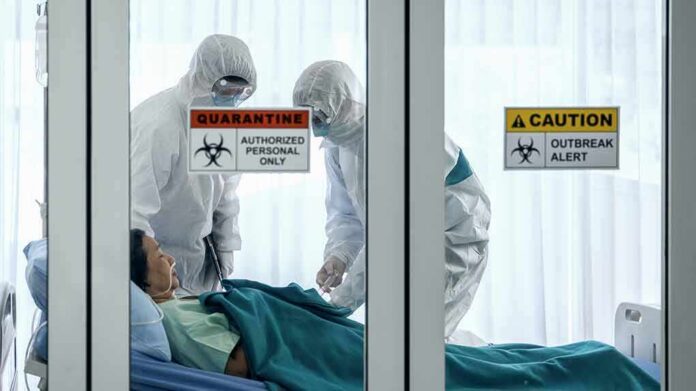
The humanitarian worker being monitored for Ebola in a London hospital is not a confirmed case, is currently well and asymptomatic, and their evacuation reflects how modern health systems manage high‑consequence infections: aggressively precautionary for the individual, but with genuinely low risk for the wider public.
Key Points
- UK authorities state there are no confirmed Ebola cases in the country and the public risk remains low.
- The worker was evacuated from DR Congo after a possible healthcare-related exposure and is being monitored in isolation for the standard 21‑day incubation period.
- Precautionary monitoring of exposed but healthy workers is routine and distinct from having a “suspected” or confirmed Ebola case.
- Ebola is rare in the UK; past cases have all involved returning healthcare workers, with no onward transmission.
From alarming headline to precise reality
When people read that a Brit is in a London hospital after “potential Ebola exposure in DR Congo,” the natural assumption is that Ebola has arrived on UK soil and that the public is at immediate risk. The evidence paints a different, calmer picture. The individual is a humanitarian worker supporting the Ebola response in the Democratic Republic of Congo, evacuated to the UK after what officials describe as a “potential healthcare-related exposure” rather than a confirmed infection. UK Health Security Agency (UKHSA) statements and BBC reporting are unusually clear: the person “has no symptoms,” “remains well,” and their transfer was undertaken “out of an abundance of caution.” There are, at this stage, no laboratory-confirmed cases of Ebola in the UK, and the risk to the general public is assessed as low.
This distinction between exposure and illness is not semantic. It drives how the case is managed clinically and how the public should interpret it. An exposed but asymptomatic worker is not classified as a “suspected case” under UKHSA’s own definitions; “suspected” is reserved for people who become unwell within 21 days of possible exposure. Recognising that difference is the key to understanding why this story sounds dramatic while, in epidemiological terms, it is routine.
How precautionary evacuation and monitoring actually work
The UK response follows a well-established pattern developed over more than a decade of dealing with Ebola and other high‑consequence infectious diseases. Ebola’s incubation period—the time from infection to onset of symptoms—is typically between two and 21 days. During that window, someone who has been exposed can feel perfectly well yet still be at risk of developing disease later. For humanitarian and healthcare workers coming back from an outbreak zone, public‑health guidance is built around that timeline.
UKHSA’s information for humanitarian aid workers states that if a person believes they were exposed but has no symptoms, they should contact their organisation and follow agreed monitoring protocols; if they become unwell within 21 days, they must seek medical assessment immediately. International guidance from the US Centers for Disease Control and Prevention (CDC) and the European Centre for Disease Prevention and Control (ECDC) reinforces the same approach: exposed travellers are asked to check their temperature twice daily for 21 days and maintain close contact with health authorities, with movement restrictions or isolation calibrated to the level of risk.
In some circumstances, particularly where an exposure is judged high‑risk or where local systems are strained by conflict and weak infrastructure—as is the case in parts of eastern DR Congo—countries will opt to evacuate workers to specialist units at home for the remainder of that monitoring period. The UK has used this model before. Public Health England previously announced that a healthcare worker with potential Ebola exposure was transported to the UK for “precautionary monitoring,” stressing that the individual had no symptoms, had not been diagnosed with Ebola, and would simply be monitored in line with the 21‑day incubation period.
What is happening now in London is essentially that protocol in action. The worker is being “assessed and monitored in isolation by infectious disease specialists at a London hospital,” with standard infection‑control measures in place. Isolation here is not an admission that the patient is infectious; it is a containment measure designed to keep risk at near zero in the unlikely event that symptoms develop.
Ebola risk to the UK: rare events, robust systems
A single story like this tends to loom large in the public imagination because Ebola is frightening: untreated, it carries an average case fatality rate around 50%, with some outbreaks reaching much higher. Yet what matters in risk assessment is not only severity but also how often a threat enters a particular system and what happens when it does. On those dimensions, Ebola in the UK is a rare event managed by robust, rehearsed systems.
Comprehensive reviews of UK cases show that Ebola virus disease has been diagnosed in just four individuals in the UK across several decades. Three of those were healthcare workers who had treated Ebola patients in West Africa during the 2014–15 epidemic; the fourth was a laboratory-acquired infection in 1976. All three modern clinical cases were treated in high‑containment isolation units—most famously at London’s Royal Free Hospital—and all recovered. There has never been person‑to‑person transmission of Ebola within the UK.
These numbers are consistent with official messaging. UKHSA and NHS guidance state that Ebola remains a low risk to the UK population, that cases in returning travellers are rare, and that specialist centres and protocols are in place for any that do occur. Government outbreak monitoring reports for the current Bundibugyo virus event in DR Congo and Uganda note that, as of late May and early June, no imported cases associated with that outbreak had been reported in the UK, and assess the risk to the UK population as low.
In practice, this means that when a potential exposure is identified, the system is designed to over‑react on the individual level—rapid evacuation, isolation, specialist assessment—precisely so that the population‑level risk can stay very small. This combination of aggressive containment and transparent reassurance is not unique to the UK; France, for example, has handled an Ebola‑infected doctor returning from DR Congo by isolating the patient in a negative‑pressure room and conducting careful contact tracing, while emphasising that Ebola spreads through direct contact with body fluids, not via airborne transmission, and that the overall public risk is limited.
Exposure, suspected case, confirmed case: why the terminology matters
Much of the confusion around events like the London hospital monitoring stems from language. Public‑health agencies use terms with precise operational meanings; media headlines often either blur those distinctions or use them for dramatic effect. Three labels are particularly important:
First, “exposure” refers to a plausible opportunity for the virus to enter the body—direct contact with infected blood or body fluids, a breach in personal protective equipment, or contamination of mucous membranes or broken skin. It is about risk, not outcome. In the case at hand, officials have described a “potential healthcare-related exposure,” which signals that the worker may have come into contact with infectious material while providing care, but does not assert that infection occurred.
Second, a “suspected case” is someone who has both epidemiological risk factors (recent travel to or work in an affected area, known exposure) and clinical symptoms compatible with Ebola within the relevant incubation period. UKHSA’s explainer defines suspected Ebola as a person who has become unwell after possible exposure in the last 21 days. Suspected cases trigger a different management pathway: isolation, rapid laboratory testing, and protection for staff.
Third, a “confirmed case” requires laboratory evidence. Blood samples are tested for viral genetic material or antigens, or for specific antibodies; only a positive result converts a suspected case into a confirmed one. It is only at that stage that the individual is known to have Ebola virus disease and that the full clinical and public‑health response—treatment, contact tracing, movement restrictions—is deployed.
In the London scenario, the worker is in the first category only: exposed, not symptomatic, not tested positive, and therefore neither suspected nor confirmed. UKHSA has explicitly said “there are currently no confirmed cases of Ebola in the UK.” Recognising that the categories are sequential rather than interchangeable helps ground the discussion in how risk actually unfolds.
DR Congo’s outbreak and why the UK is watching closely
If the UK risk is low, why the intense attention? Because the source outbreak in DR Congo is serious, complicated, and unfolding in a context that magnifies uncertainty. The current event, caused by Bundibugyo virus (one of the Ebola species), has been declared a Public Health Emergency of International Concern by the World Health Organization. Africa CDC and WHO briefings describe hundreds of confirmed cases, substantial death tolls, and thousands of suspected cases, concentrated in provinces where conflict, displacement, and attacks on health facilities make basic outbreak control difficult.
Field workers, like the Brit now in a London hospital, operate in environments where isolation wards have been burned, aid corridors blocked, and large numbers of potential contacts are effectively unreachable. Under those conditions, even with excellent training and protective equipment, exposure risk is not abstract. That is precisely why UK guidance for humanitarian organisations emphasizes pre‑deployment training, strict adherence to infection‑control protocols, and clear pathways for post‑exposure reporting and evacuation.
The UK’s decision to step up financial and technical support to help stop the spread of Ebola in eastern DR Congo fits this picture. Helping to contain the outbreak at source reduces the risk to neighbouring countries and to returning workers, and aligns with the wider trend toward treating severe infectious disease threats as global, not merely local, problems.
Media, perception, and the gap between danger and dread
Despite this structured reality, public perception often lives elsewhere. Ebola’s high fatality, vivid symptoms, and history in popular culture mean that even a single precautionary evacuation feels ominous. Prior UK Ebola coverage—such as the cases of William Pooley and Pauline Cafferkey—cemented the idea that a returning healthcare worker with Ebola is headline news. Against that backdrop, headlines that pair “Brit,” “London hospital,” and “Ebola” can easily blur a monitored exposure with an active case.
The result is a familiar pattern: agencies stress that “the risk to the general public remains low”; technical documents distinguish exposure from disease; yet the absence of granular, real‑time information about the specific incident leaves space for speculation. Questions that matter clinically—exactly how the exposure occurred, whether personal protective equipment failed, whether any contacts in transit needed follow‑up—are usually documented in internal incident reports rather than public releases. That restraint is understandable from a privacy and operational standpoint, but it does mean that reassurance must rest on trust in the system rather than on detailed case narratives.
For a 40‑plus audience used to weighing health risks critically, the takeaway is not that officials are minimising danger, but that they are applying a calculus shaped by hard experience. Ebola is taken extremely seriously; robust systems exist to prevent it spreading in the UK; exposures among humanitarian workers are managed aggressively, often more stringently than raw numbers alone would demand. Fear is inevitable, but it need not be the organising principle.
What this means going forward
Looking ahead, cases like the London hospital monitoring will recur as long as outbreaks in places like DR Congo continue. Some evacuated workers will never fall ill; a few, in the UK or elsewhere, will eventually test positive and join the short list of imported Ebola cases managed in high‑income settings. Each event will stress-test the balance between transparency, precaution, and proportionate public messaging.
For individuals, the practical guidance stays constant: Ebola does not spread casually, is not airborne in normal circumstances, and requires direct contact with infected body fluids or contaminated materials. For populations, the presence of a monitored worker in a London isolation unit is evidence that surveillance and containment systems are functioning as intended, not that Ebola is silently spreading through the community.
The Brit in the London hospital after potential Ebola exposure in DR Congo is thus best understood not as a harbinger of domestic crisis, but as a visible point in a much larger web of global health practice—where people who volunteer to confront dangerous pathogens are backed, when something might go wrong, by systems designed to protect both them and the societies to which they return.
A British humanitarian worker is being monitored in isolation at a London hospital after being exposed to Ebola in the Democratic Republic of Congohttps://t.co/DIEUghy8b6
— The Daily Record (@Daily_Record) July 21, 2026
How to read similar stories with a critical eye
When similar headlines appear in the future, a few simple questions can help distinguish signal from noise. Is the person described as exposed, suspected, or confirmed? Are they symptomatic? Has a laboratory diagnosis been reported? What do national health agencies say about public risk, and how does that align with the known base rate of cases in the country? In the UK context, where Ebola has appeared only in a handful of imported cases and has never spread from person to person, the presence of an isolated, monitored worker should prompt concern for that individual and respect for their work—but not panic.
Sources:
independent.co.uk, telegraph.co.uk, gov.uk, bbc.co.uk, bbc.com, ukhsa.blog.gov.uk, en.wikipedia.org, youtube.com, london.gov.uk, cbsnews.com, assets.publishing.service.gov.uk, cdc.gov, ecdc.europa.eu, pmc.ncbi.nlm.nih.gov, who.int, nhs.uk