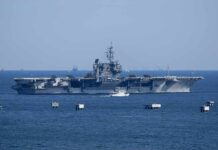

China is quietly finishing a giant naval supply ship that could let its warships roam the globe while America argues over budgets at home.
Story Snapshot
- Commercial satellites show a huge Chinese replenishment ship under construction near Guangzhou, likely bigger than any support ship now at sea.
- Analysts say the ship is built to keep Chinese aircraft carriers fueled and armed far from home, shrinking America’s Pacific advantage.
- Beijing has not released basic facts about the vessel, leaving citizens to rely on outside imagery and expert guesses.
- The project highlights how fast China’s shipyards are moving while many Americans believe Washington’s “elites” are asleep at the wheel.
China’s Mega Supply Ship Takes Shape
Satellite images from early 2026 show a huge hull in a dry dock at Longxue Island shipyard near Guangzhou, China. Analysts measuring the dock and cranes say the ship is about 270 to 271 meters long and around 37 meters wide, roughly 885 feet by 121 feet. That makes it larger than China’s current Type 901 fast combat support ships, which already displace about 50,000 tons. The new vessel appears to have forward and aft superstructures, a long open deck, and features typical of at-sea resupply ships.
Defense outlets and regional media describe the ship as a “mega-replenisher” or “monster supply ship” meant to support People’s Liberation Army Navy carrier groups on long missions. Several reports, based on hull shape and draft estimates, suggest a full-load displacement of roughly 60,000 to 65,000 tons, which would put it among the largest naval support ships ever built. Some analysts say it could surpass retired United States Sacramento-class support ships in overall size, hinting that China may soon operate the world’s biggest dedicated replenishment vessel.
Why This Matters For Carrier Power And The Pacific
Modern navies cannot fight far from home without large supply ships that bring fuel, ammunition, spare parts, and food at sea. China has been adding more Type 903 and Type 901 replenishment ships for years to support its growing fleet. A larger follow-on ship at Longxue would push this trend further, giving Chinese carrier groups more “legs” to operate near places like Taiwan, Japan, or even the Indian Ocean without needing friendly ports. Asia Times notes that such a mega-oiler could weaken America’s edge, which still relies heavily on fixed bases and long supply lines across the Pacific.
For Americans who watch China’s rise with worry, the concern is simple: Beijing is building the support network that makes long wars at sea possible, while Washington struggles to pass basic budgets and keep shipbuilding programs on track. Conservatives see another example of global rivals racing ahead while United States leaders chase “woke” priorities and pile on debt. Liberals see military-industrial money flowing overseas as domestic inequality grows. Both sides can look at this ship and ask whether anyone in the federal government is truly planning for the next Pacific crisis.
Secrecy, Uncertainty, And Media Spin
Despite the strong imagery, there are still gaps. China has not officially named the ship, released its tonnage, or clearly stated its mission. No public shipyard filings, navy statements, or detailed engineering documents confirm the exact displacement, cargo capacity, or propulsion. Even careful outlets like Janes stress that the identification is an “assessment” based on the vessel’s size and visible features, not a formal class assignment. That means “world’s largest” claims remain educated guesses, not proven facts.
This lack of hard data opens the door to spin. Some coverage treats the ship as a near-certain game changer tied directly to a future Type 004 supercarrier, even though official planning documents have not been made public. Opinion pieces and social posts then echo these claims, turning cautious estimates into “done deals” in the public mind. On the other side, some voices dismiss the story as hype or propaganda, even though the hull plainly exists. Citizens are left sorting fear, denial, and fact on their own, without honest briefings from leaders.
What It Reveals About Power, Elites, And Shipyards
The Longxue ship also fits a wider pattern: China uses huge, efficient shipyards to mass-produce warships and support vessels at a pace no other country matches. Recent reporting shows Chinese yards taking more than half of global ship orders and building dozens of navy hulls in just a few years. United States and allied shipyards, bound by red tape, labor disputes, and budget fights, move far slower. Many Americans on both the right and left see this and feel their own “elite” leaders have let key industries and defenses hollow out.
A fake story from Fox News: "An enormous vessel taking shape near Guangzhou, China, appears designed to refuel, rearm and resupply Chinese carrier groups far from home. At roughly 885 feet long, it could become the world’s largest dedicated naval replenishment ship." No such item
— The Yin Investment Group (@YinGroup) July 22, 2026
For citizens who distrust the so-called deep state, the Longxue project is a warning sign. Chinese planners quietly build the boring but vital ships that keep fleets running, while Washington elites argue, posture, and sometimes seem more focused on reelection than on logistics. At the same time, Beijing’s secrecy means its own people also lack a clear say in how their taxes and labor are used. In both systems, ordinary workers and families watch massive war machines grow, yet feel shut out of the real decisions.
Sources:
janes.com, meta-defense.fr, instagram.com, timesofindia.indiatimes.com, scmp.com, eurasiareview.com