
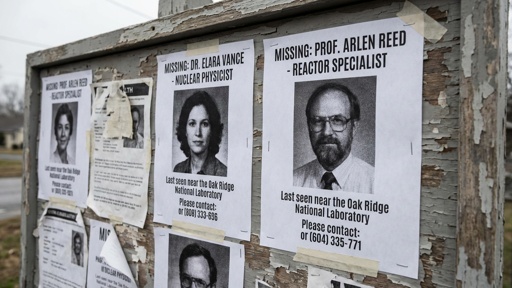
Ten government scientists working on classified nuclear and aerospace programs have vanished or died under mysterious circumstances since mid-2023, prompting the Trump administration to pledge a federal investigation into what security experts warn could be a targeted campaign against America’s most sensitive research personnel.
A Pattern Emerges from America’s Most Secure Labs
The cascade of disappearances reads like a spy thriller, except the victims are real people with security clearances and access to programs most Americans will never know exist. Monica Reza vanished while hiking in California in early 2025, leaving behind her phone and wallet. Steven Garcia disappeared from Albuquerque on August 28, 2025. Frank Maiwald, another NASA Jet Propulsion Laboratory scientist, died under undisclosed circumstances. Each case, viewed alone, might seem unremarkable. Collectively, they form a disturbing mosaic that has security professionals raising red flags about potential espionage, targeted elimination, or systematic breaches at facilities handling the nation’s most classified work.
The scientists worked at the crown jewels of American defense research: Los Alamos National Laboratory, where the atomic bomb was born; NASA’s Jet Propulsion Laboratory, pioneer of space exploration; and the Kansas City National Security Campus, which manufactures nuclear weapon components. These aren’t low-level researchers. Major General William McCasland commanded the Air Force Research Laboratory before his February 2026 disappearance from his New Mexico home. When people with this level of access start vanishing, leaving personal effects behind like discarded props in an abandoned stage play, the implications extend far beyond individual tragedies.
White House Acknowledgment Signals Gravity of Situation
Karoline Leavitt’s April 15, 2026, press briefing marked the first official White House recognition of the pattern. Her carefully measured response balanced skepticism with concern, stating she hadn’t yet consulted relevant agencies but would certainly do so if the reports proved accurate. This measured approach reflects the administration’s position: take the threat seriously without fueling conspiracy theories. Rep. Eric Burlison had already pushed for FBI involvement in March, calling the disappearances deeply concerning. The contrast between congressional urgency and executive caution reveals the delicate balance required when addressing potential threats to classified programs without exposing vulnerabilities or legitimizing unsubstantiated speculation.
The timeline matters. These cases began accumulating in mid-2023, coinciding with renewed White House directives for NASA and the Pentagon to accelerate nuclear space reactor development. The U.S. government is racing to deploy nuclear propulsion systems for deep space missions and military applications, technology that would revolutionize both exploration and defense capabilities. Scientists working on these programs possess knowledge that hostile nations would pay dearly to acquire. Whether through recruitment, coercion, or elimination, targeting these individuals could set American programs back years while advancing competitor nations’ capabilities. The abandoned personal items suggest haste or force, not voluntary departure.
The Nuclear and UFO Connection Raises Questions
Several victims had documented connections to UFO research alongside their nuclear expertise, a dual focus that adds layers of intrigue. The government’s recent transparency push on unidentified aerial phenomena has brought previously ridiculed research into mainstream defense discourse. Scientists studying both nuclear technology and unexplained aerial objects occupy a unique intersection of classified work. Security experts note this overlap could make them particularly valuable targets for foreign intelligence services seeking insights into both American capabilities and unknowns that might represent advanced technology. The convergence of these research areas at facilities like Los Alamos, where nuclear weapons meet cutting-edge physics, creates a concentration of knowledge that adversaries would find irresistible.
Harvard astrophysicist Avi Loeb, commenting on the growing list, acknowledged the proximity of these scientists to sensitive data without endorsing conspiracy theories. His measured reaction reflects the scientific community’s broader concern: these individuals held institutional knowledge that cannot be easily replaced. Training scientists to security-clearance levels for classified nuclear and aerospace work requires years and millions of dollars. Each disappearance represents not just a human tragedy but a strategic loss to American research capabilities. The pattern suggests either extraordinary coincidence or something far more sinister, and national security logic demands treating it as the latter until proven otherwise.
What Happens Next Determines American Security Posture
The administration faces pressure to balance transparency with operational security. Launching a high-profile investigation could reveal vulnerabilities in facility security or personnel vetting, potentially encouraging additional targeting. Ignoring the pattern risks losing more irreplaceable expertise and demoralizing scientists who already work under intense pressure in isolated, high-security environments. The FBI’s involvement, if it materializes beyond Burlison’s request, would signal federal law enforcement treating these cases as potentially connected rather than isolated incidents. That shift would trigger coordinated counterintelligence measures across multiple agencies and facilities, fundamentally altering security protocols at America’s most sensitive research sites.
Families of the missing live in agonizing uncertainty while the scientific community watches nervously. Morale at national laboratories suffers when colleagues vanish without explanation. Recruitment becomes harder when potential candidates weigh career opportunities against mysterious risks. The economic implications extend beyond individual facilities: delays in nuclear space propulsion programs could cost billions and cede strategic advantages to China and Russia, both aggressively pursuing similar technologies. If investigations reveal systematic targeting, expect dramatic increases in security spending, personnel monitoring, and potentially restrictions on movement and communication for scientists working on classified programs. The balance between protecting researchers and maintaining the collaborative environment necessary for innovation will test policymakers’ wisdom.
Sources:
Multiple US scientists reported dead or missing – TRT World
White House looking into cases of American scientists who disappeared or died – Washington Examiner
White House responds after US scientists reported missing or dead – Tyla